Born to Race, Learning to Win: Inside Freddie Rowe's Rise
Freddie Rowe arrived in Rieti among the favourites for the European U18 1500m title, then had to prove it on the track. He talks tactical patience, turning natural speed into racing intelligence, and the World U20 disappointment that sharpened his season.
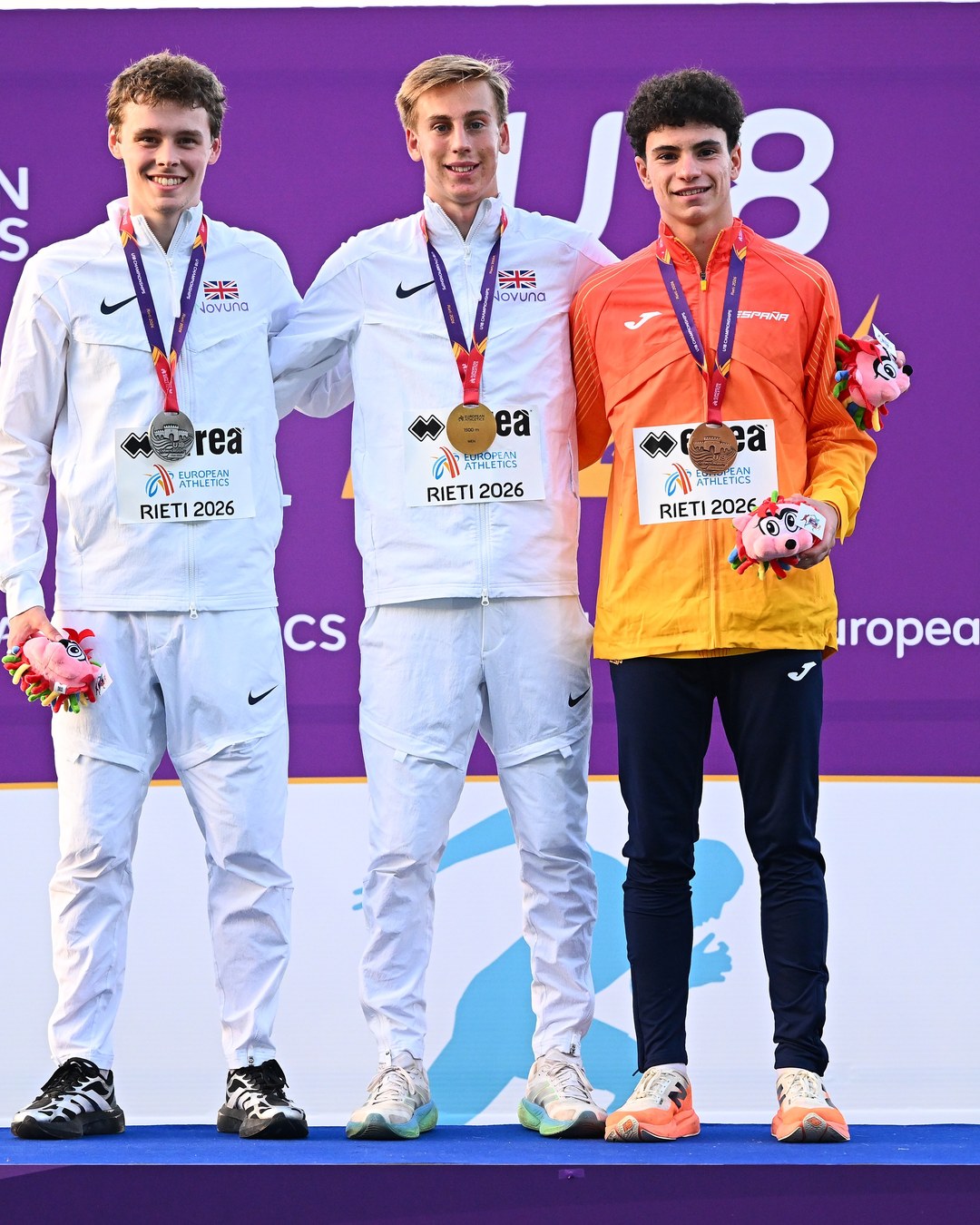
Freddie Rowe had the speed to win, but time was closing in on him. At the European U18 Championships, with the title within reach and the pressure mounting, he knew the moment to strike would determine whether expectation became reality.
Waiting for the right moment
At the bell of the European U18 1500m final, Freddie Rowe resisted the temptation to make his move.
He had arrived in Rieti among the favourites, carrying the expectations created by a remarkable breakthrough season. But with one lap remaining, reputation meant little. The race still had to be won.
"I knew I needed to stay on the leader's shoulder," Rowe recalled, "I didn't want to make the move just yet."
The leader pushed hard down the back straight. Rowe followed, waiting for the moment when patience needed to become aggression.
"Just before 200m, I put my foot down and checked to see Alistair behind me. Then, after I kicked again with 100m to go, I was certain I wasn't going to get caught."
Rowe crossed the line in 3:55.33 to become the European U18 1500m champion, leading teammate Alistair Street to a British one-two.
His first emotion was not celebration. It was relief.
"It was a lot of weight off my shoulders, coming in as favourite," he says. "It gave me confidence to know that I could handle the pressure and external noise coming into such a difficult final."
A competitor from the beginning
Long before international medals and comparisons with British middle-distance greats such as Steve Cram, Steve Ovett and even Sir Roger Bannister, Rowe was drawn to running by something much simpler.
Competition and the joy of running.
"I think originally it was all just a bit of fun," he stated, "I liked to be competitive regardless of the sport, so I enjoyed those races right at the start."
He joined Havering Athletic Club in Year 6 and although his approach to training has since changed considerably, his underlying motivation has not.
"I've stayed quite similar to my Year 6 self in just wanting to race and win in all of my races."
As a younger athlete, Rowe completed two weekly track sessions but did little running outside them. He followed the instructions he was given without thinking too deeply about the wider process.
That began to change when stronger performances at national races showed him what might be possible.
"I started to realise that if I took it a bit more seriously, I could perform a lot better."
Turning ability into performance
The decisive change came when Rowe joined his current coach, Pat Gahagan. His workload increased from approximately two or three runs per week to around five, supported by more frequent quality sessions.
His improvement was dramatic. After running 3:59 for 1500m in 2024, Rowe produced a breakthrough 3:44.62 at the St Mary's British Milers' Club meeting in 2025.
"The 3:44 was the big one," he stated, "I knew I had a performance like that in me; I just didn't have the opportunity to run something like that until St Mary's BMC."
In May 2026, he lowered his best to 3:40.26. The performance placed him second on the British age 17 all time list, just 0.17 seconds behind Steve Cram's mark.
Rowe does not attribute that progression to a secret session or sudden transformation.
"I'd say it's down to more consistency," he explained, "I had run decently well off not much running at all, so even just a few easy runs a week really boosted my fitness. That brought along a lot of confidence too."
The breakthrough appeared sudden on the results page, yet in truth his ability and talent had always been there, quietly strengthened by months of consistent training.
The speed was natural. The tactics were learned.
Rowe's range makes him particularly dangerous over 1500m. He has developed 400m and 800m speed while continuing to use cross-country to build strength during the winter.
"As a middle-distance runner, it's hugely important to have a range of good times around your main event."
His finishing speed, however, predates the training that has made him one of Britain's leading young runners.
"For as long as I can remember, I've usually had something to close hard with."
What Rowe had to learn was how to use it and when to deploy it.
"Tactical racing is a tricky one to get good at because it takes a lot of losses and mistakes to understand when to make your move and how to make it."
He considers several possible scenarios before competing but rarely commits to one fixed plan. In championship races, he allows the opening lap to reveal how the contest is developing before adapting to the athletes around him.
That judgement was visible in Rieti. Rowe did not allow the pressure of being the favourite to force him into an early move. He waited, responded and then committed decisively.
His speed may have been innate, strengthened by years of dedicated training, but the patience and intelligence to use it were forged through countless races and lessons that only experience can deliver.
Pressure beyond the track
Rowe's development has taken place alongside A levels and the ordinary demands of being 17.
His typical training week includes hard track sessions on Monday and Wednesday, easy runs on Tuesday and Thursday, rest on Friday, a Saturday race or rest day and a longer run on Sunday.
"The balance between running and A levels is still an unsolved problem," he admits. "The main thing I try to do is stay organised and know when things need to be completed or handed in."
Travelling, training and competing have consumed much of his free time. However, Rowe still works to preserve time for friends and family, and although he recognises the sacrifices, he has never truly questioned them as running has always been the path he returns to.
"In the end, I chose to run, and I knew the sacrifices that came along with it."
Learning from disappointment
Even his breakthrough season has not been without setbacks.
Rowe ran inside the qualifying standard for the World U20 Championships but was not selected for the British team. He felt the criteria were unclear for an U18 athlete seeking selection for a track event.
"Not being selected was quite difficult for me to take," he acknowledged.
The decision was outside his control. His response was not.
"It taught me a lot about how to manage disappointment and use that to motivate myself to continue my season and keep improving."
That lesson may prove as valuable as anything he has learned from winning. The setback ignited his determination, fuelling his 1:47.95 run at the Tooting BMC, a time that ranks him second in the UK for Under-18s.
Still wanting to race
The European U20 Championships are now the primary target, alongside improving his personal bests and placing himself in winning situations as often as possible.
However, his advice to younger athletes is not about times, mileage or medals.
Enjoy it. As generic as it may be, it is the truest thing I've heard. Get a good group to train with, a group of runners who want to do well and push you, especially if they are your friends as well. Freddie Rowe
The athlete who waited for the perfect moment in Rieti is far more disciplined, wiser and tactically assured than the ten year old who first fell in love with competing.
Yet, the instinct underneath has never changed.
Freddie Rowe still races to win, only now he has the patience, judgement and speed to turn that instinct into reality.